| |||||

• polskie
• Zamów informacje o nowościach z wybranego tematu • kontakt |
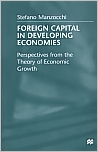
FOREIGN CAPITAL IN DEVELOPING ECONOMIESMANZOCCHI Swydawnictwo: ST.MARTIN PRESS, 1999, wydanie Icena netto: Foreign Capital in Developing Economies The object of this volume is to evaluate the pattern and the function of foreign capital in developing countries in a long-run perspective. The main conceptual instruments employed are the theory of economic growth, and the techniques associated with recent advances in growth econometrics. This empirical work points out that there is no mechanical trade-off between the short-term dangers and the long-run gains from capital market integration, but the growth benefits of foreign capital in transforming economies are conditional on an effective destination of the resources. Over-borrowing and excessive consumption are the main pitfalls in the short- as in the long-run. Nevertheless, foreign capital can be conducive to faster growth and possibly higher welfare. Contents: Foreword; E.R.Grilli Acknowledgements List of Tables Introduction: A Growth-theory Approach to Capital Flows in Developing Countries Recovery, Insolvency and Stagnation: Foreign Capital to Developing Economies in Historical Perspective PART I: THEORETICAL MODELS Growth Theory and the Determinants of Capital Flows Growth Theory and the Effects of Capital Flows PART II: EMPIRICAL STUDIES Measuring Capital Mobility in Developing Economies Determinants of Net Capital Flows in Developing Countries Capital Movements, Economic Growth and Investment in Developing Countries External Finance and Foreign Debt in the Transition Economies of Central Eastern Europe Bibliography Index Author Biographies: STEFANO MANZOCCHI is Associate Professor of Economics, University of Perugia. He has been a Visiting Scholar, Research Department, International Monetary Fund, Washington, DC, 1996; a consultant for the European Union and for the Research Centre on the Italian and European Economy. He has published on capital flows and external finance in a range of major economic journals. 224 pages Księgarnia nie działa. Nie odpowiadamy na pytania i nie realizujemy zamówien. Do odwolania !. |