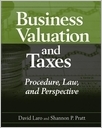
Disputes over valuation issues fill the court's dockets and for good reason, fair
market valuations are required frequently by the law. The authors believe that
approximately 243 sections of the Code and several thousand references in the Regulations
explicitly require fair market value determination. Consequently, taxpayers file an
estimated 15 million tax returns each year reporting an event involving a valuation
related issue. It is no mystery, therefore, why valuation cases are ubiquitous. Today,
valuation is an important and highly sophisticated process. Valuators need legitimate
guidance to perform their work. The objective of this book is to provide knowledge, and
guidance to those who do the valuations as well as those who are affected by them.
This unprecedented text provides:
Clear guidance and perspective on business valuation from two of the nation's
top authorities, Hon. David Laro and Dr Shannon Pratt.
Insightful perspective and discussion on critical issues, procedures and law
pertaining to business valuation.
An overview of business valuation procedures
Law and techniques of Fair Market Value Opinion from the Hon. David Laro and
Dr. Shannon Pratt who express their unique and critical views.
The business valuer with everything from the basics to the sophisticated. From
definitions to valuing complex business interests, what you need to know about business
valuation.
Everything from empirical market evidence to credible expert business valuation
testimony discussed and analyzed by the Hon. David Laro and Dr. Shannon Pratt.
DAVID LARO was appointed by President Bush to the United States Tax
Court, confirmed by the Senate, and vested as a federal judge in November 1992. He
formerly practiced law in Flint and Ann Arbor, Michigan, specializing in tax law for
twenty-four years. Judge Laro was chairman and CEO of a publicly traded international
company and cofounded Republic Bancorp, a Michigan bank holding company. He is an adjunct
professor of law at Georgetown University Law Center, a visiting professor at the
University of San Diego Law School, and a lecturer at Stanford Law School. He is a
frequent guest speaker and has written numerous articles on taxation.
SHANNON P. PRATT's reputation for knowledge and experience in the
field of business valuation is legendary and unparalleled. As managing owner of Business
Valuation Resources, LLC, he is the Editor-in-Chief of the monthly newsletter Shannon
Pratt's Business Valuation Update. He has authored or coauthored several industry-standard
books, including Valuing a Business: The Analysis and Appraisal of Closely Held Companies;
Valuing Small Business and Professional Practices; Cost of Capital: Estimation and
Applications; and Business Valuation Body of Knowledge (Wiley). He formed Willamette
Management Associates and presently practices business valuation as an independent
consultant.
Table of Contents
Forewords.
Preface.
Acknowledgments.
1. Standards of Business Valuation.
Summary.
Introduction.
Sources for Defining Value.
Definitions of Value.
Premise of Value.
Conclusion.
2. Subsequent Events.
Summary.
Key Question.
Valuation Date.
Subsequent Events-Exceptions.
Conclusion.
3. Business Valuation Experts.
Summary.
Introduction.
Proving Business Value.
The Expert Appraiser.
Types of Experts.
Various Roles of Experts.
Business Valuation Litigation Witnesses.
Admissibility of Evidence Underlying Expert Opinions.
Limitations to Admissibility.
Reliability of the Expert.
Minimum Thresholds for the Business Valuation Expert.
Sarbanes-Oxley Act of 2002.
Attorney Assistance to the Expert.
Qualified Appraiser.
Concerns about Expert Testimony.
Court-Appointed Expert.
Conclusion.
Appendix: Expert Credentials and Qualifications.
4. Sources of Law and Choice of Courts.
Summary.
Structure of the American Legal System.
Tax Law.
Tax Litigation.
5. Burden of Proof in Valuation Controversies.
Summary.
Burden of Proof.
Who Bears the Burden of Proof.
Burden of Proof: Exceptions to the General Rule.
6. Penalties and Sanctions.
Summary.
Introduction.
What You Need to Know.
Valuation Penalties.
General Penalties.
Discretionary Sanctions.
7. Valuation and Choice of Entity.
Summary.
Introduction.
Corporations.
Limited Liability Companies.
General Partnerships.
Limited Partnerships.
Sole Proprietorships.
Valuation Considerations.
Choice of Jurisdiction.
Conclusion.
8. Valuation of S Corporations and Other Pass-Through Tax Entities: Minority
and Controlling Interests.
Introduction.
Case Law Background.
S Corporation Minority Interest Appraisals.
Comparison of Minority Interest Theories-A Summary of the Issues.
S Corporation Controlling Interest Appraisals.
Summary.
S Corporation Valuation Issues-Partial Bibliography.
9. Valuation of International Transactions.
Summary.
Introduction.
Transfer Pricing.
Customs Valuation.
Conclusion.
10. Adjustments to Financial Statements.
Summary.
Separating Nonoperating Items from Operating Items.
Addressing Excess Assets and Asset Deficiencies.
Handling Contingent Assets and Liabilities.
Adjusting Cash-Basis Statements to Accrual-Basis Statements.
Normalizing Adjustments.
Controlling Adjustments.
Conclusion.
11. Comparative Financial Statement Analysis.
Summary.
Comparable Ratio Analysis.
Common Size Statements.
Tying the Financial Statement Analysis to the Value Conclusion.
Conclusion.
12. Economic and Industry Analysis.
Summary.
Objective of Economic and Industry Analysis.
National Economic Analysis.
Regional and Local Economic Analysis.
Industry Analysis.
Conclusion.
Partial Bibliography of Sources for Economic and Industry Analysis.
13. Site Visits and Interviews.
Summary.
Site Visits.
Management Interviews.
Interviews with Persons Outside the Company.
Conclusion.
14. The Income Approach.
Summary of Approaches, Methods and Procedures.
Introduction to the Income Approach.
Net Cash Flow: The Preferred Measure of Economic Benefit in the Income Approach.
Discounting versus Capitalizing.
Relationship between Discount Rate and Capitalization Rate.
Projected Amounts of Expected Returns.
Developing Discount and Capitalization Rates for Equity Returns.
Weighted Average Cost of Capital (WACC).
The Midyear Convention.
The Income Approach in the Courts.
Conclusion.
Appendix: An Illustration of the Income Approach to Valuation.
15. The Market Approach.
Summary.
The Market Approach.
Revenue Ruling 59-60 Emphasizes Market Approach.
The Guideline Publicly Traded Company and the Guideline Transaction (Merger and
Acquisition) Method.
How Many Guideline Companies?
Selection of Guideline Companies.
Documenting the Search for Guideline Companies.
Choosing Multiples Based on Objective Empirical Evidence.
What Prices to Use in the Numerators of the Market Valuation Multiples.
Choosing the Level of the Valuation Multiple.
Selecting Which Valuation Multiples to Use.
Assigning Weights to Various Market Multiples.
Sample Market Valuation Approach Tables.
Other Methods Classified under the Market Approach.
Conclusion.
Appendix: An Illustration of the Market Approach to Valuation.
16. The Asset-Based Approach.
Summary.
The Adjusted Net Asset Value Method.
Excess Earnings Method (The Formula Approach).
Conclusion.
17. Entity-Level Discounts.
Summary.
Trapped-In Capital Gains Discount.
Key Person Discount.
Portfolio (Nonhomogeneous Assets) Discount.
Discount for Contingent Liabilities.
Conclusion.
18. Discounts for Lack of Marketability.
Summary: General Introduction to Shareholder-Level Discounts and Premiums.
Definition of Marketability.
Benchmark for Marketability Is Cash in Three Days.
Investors Cherish Liquidity, Abhor Illiquidity.
Degrees of Marketability or Lack Thereof.
Empirical Evidence to Quantify Discounts for Lack of Marketability: The Restricted Stock
Studies.
Empirical Evidence to Quantify Discounts for Lack of Marketability: Pre-IPO Studies.
Criticisms of the Pre-IPO Studies.
Factors Affecting the Magnitude of Discounts for Lack of Marketability.
Use of the Databases for Quantifying Discounts for Lack of Marketability.
Discounts for Lack of Marketability in the Courts.
Conclusion.
Partial Bibliography of Sources for Discounts for Lack of Marketability.
19. Other Shareholder-Level Discounts.
Summary.
Minority Discounts/Control Premiums.
Voting versus Nonvoting Shares.
Blockage.
Discounts for Undivided Fractional Interests in Property.
Conclusion.
20. Weighting of Approaches.
Summary.
Theory and Practice.
Mathematical versus Subjective Weighting.
Examples of Weighting of Approaches.
Conclusion.
21. Valuation of Options.
Summary.
Introduction and Background.
General Principles of Option Valuation.
Specific Rules for Valuing Options.
Conclusion.
22. IRS Positions.
Summary.
Introduction.
Rev. Rul. 59-60.
Rev. Rul. 65-192.
Rev. Rul. 65-193.
Rev. Proc. 66-49.
Rev. Rul. 68-609.
Rev. Proc. 77-12.
Rev. Rul. 77-287.
Rev. Rul. 83-120.
Rev. Rul. 85-75.
Rev. Rul. 93-12.
Tax Advice Memorandum 1994-36-005.
Rev. Proc. 2003-51.
Conclusion.
23. Business Appraisal Reports.
Summary.
Business Valuation Report-Writing Standards.
Elements of the Business Valuation Report.
Organization of the Report.
Qualities of a Good Appraisal Report.
Conclusion.
24. Questions to Ask Business Valuation Experts.
Summary.
Qualifications.
Financial Statement Adjustments and Analysis.
Economic and Industry Data.
Site Visits and Interviews.
General Questions about Methodology.
Discount and Capitalization Rates in the Income Approach.
Projections Used in the Income Approach.
Market Approach.
Asset-Based Approach.
Entity-Level Discounts.
Minority Interest Discounts/Control Premiums.
Discounts for Lack of Marketability.
Voting/Nonvoting Stock.
Questions about Contradictory Prior Testimony.
Appendix A: IRS Business Valuation Guidelines.
Appendix B: International Glossary of Business Valuation Terms.
Appendix C: Bibliography.
Appendix D: Table of Cases.
Index.
Hardcover, 480 pages
Księgarnia nie działa. Nie odpowiadamy na pytania i nie realizujemy zamówien. Do odwolania !.